• Skip to main content
  • Skip to secondary menu
  • Skip to primary sidebar
OrthopaedicPrinciples.com

OrthopaedicPrinciples.com

Integrating Principles and Evidence

Integrating Principles and Evidence

  • Home
  • Editorial Board
  • Our Books
    • Evidence Based Orthopaedic Principles
  • Courses
  • Exams
  • Reviews
  • Live Program
  • Contact

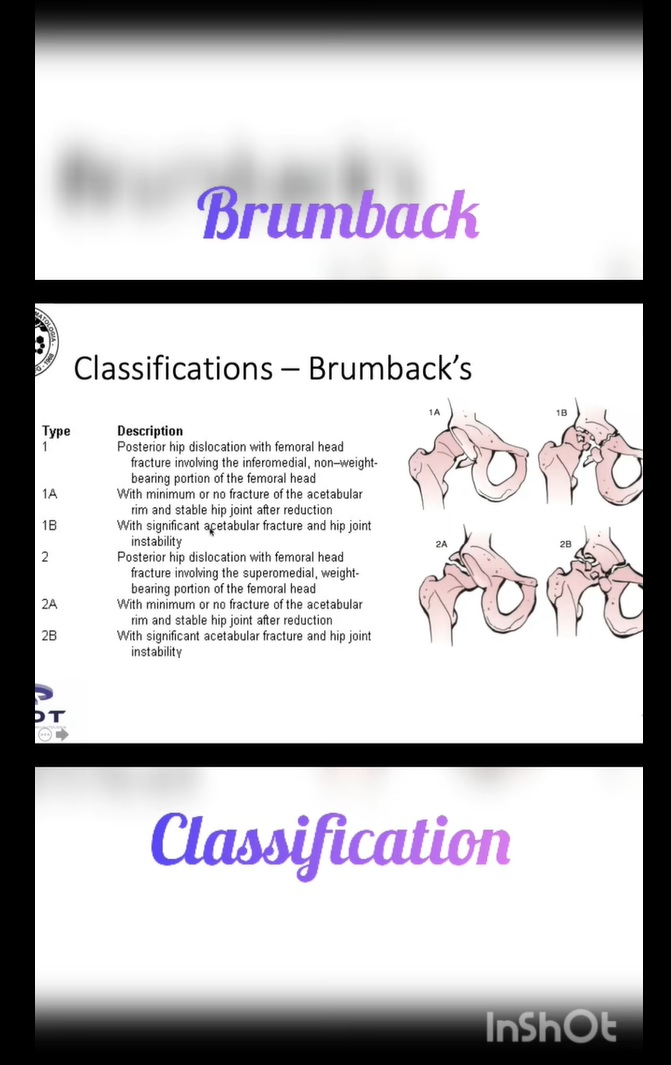
Brumback Classification of Femoral Head Fractures

Orthopaedic Principles Shorts Channel

Type 1: posterior hip dislocation with fracture of femoral head involving inferomedial (non weight bearing) portion of femoral head.

  • Type 1A, with minimal or no fracture of acetabular rim and stable hip joint after reduction.
  • Type 1B, with significant acetabular fracture and hip joint instability.

Type 2: posterior hip dislocation with fracture of femoral head involving superomedial (weight bearing) portion of femoral head.

  • Type 2A, with minimal or no fracture of acetabular rim and stable hip joint after reduction.
  • Type 2B, with significant acetabular fracture and hip joint instability

Type 3: dislocation of hip (unspecified direction) with femoral neck fracture.

  • Type 3A, without fracture of femoral head.
  • Type 3B, with fracture of femoral head.

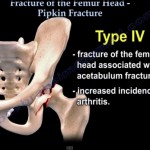
Type 4: anterior dislocation of hip with fracture of femoral head.

  • Type 4A, indentation type, depression of superolateral surface of femoral head.
  • Type 4B, shear type, depression of superolateral surface of femoral head.

Type 5: central fracture-dislocation of hip with femoral head fracture.

Ref:
Brumback RJ, Kenzora JE, Levitt LE, et al. Proceedings of the hip society, 1986. St. Louis: CV Mosby; 1987. p. 181–206
Post Views: 3,986

Related Posts

  • Femoral Head fractures

    Courtesy: Dr Leandro Alves de Oliveira MD, COT Goiânia, Brazil

  • Fractures of the Femoral Head

    Courtesy: Prof Nabil Ebraheim, University of Toledo, Ohio, USA

  • Hip dislocation and Femoral head fractures

    Courtesy: Saqib Rehman MD Director of Orthopaedic Trauma Temple University, Philadelphia, Pennsylvania, USA

Reader Interactions

Leave a Reply

Your email address will not be published. Required fields are marked *

Primary Sidebar

Follow Us

instagram slideshare

Categories

  • -Applied Anatomy
  • -Approaches
  • -Basic Sciences
  • -Cartilage & Meniscus
  • -Classifications
  • -Examination
  • -Foot and Ankle
  • -Foot and Ankle Trauma
  • -FRCS(Tr and Orth) tutorials
  • -Gait
  • -Hand and Wrist
  • -Hand and Wrist Trauma
  • -Hand Infections
  • -Hip and Knee
  • -Hip Preservation
  • -Infections
  • -Joint Reconstruction
  • -Knee Arthroplasty
  • -Knee Preservation
  • -Metabolic Disorders
  • -Oncology
  • -OrthoBiologics
  • -OrthoPlastic
  • -Paediatric Orthopaedics
  • -Paediatric Trauma
  • -Patellofemoral Joint
  • -Pelvis
  • -Peripheral Nerves
  • -Principles
  • -Principles of Surgery
  • -Radiology
  • -Rheumatology
  • -Shoulder and Elbow
  • -Shoulder and Elbow Arthroplasty
  • -Spine Deformity
  • -Spine Oncology
  • -Spine Trauma
  • -Spine, Pelvis & Neurology
  • -Sports Ankle and Foot
  • -Sports Elbow
  • -Sports Knee
  • -Sports Medicine
  • -Sports Medicine Hip
  • -Sports Shoulder
  • -Sports Wrist
  • -Statistics
  • -Technical Tip
  • -Technology in Orth
  • -Trauma
  • -Trauma (Upper Limb)
  • -Trauma Life Support
  • -Trauma Reconstruction
  • Book Shelf
  • Book Shelf Medical
  • Careers
  • Case Studies and Free Papers
  • DNB Ortho
  • Evidence Based Orthopaedic Principles
  • Evidence Based Orthopaedics
  • Exam Corner
  • Fellowships
  • Guest Editor
  • Guest Reviews
  • Image Quiz
  • Instructional Course Lectures
  • Journal Club
  • MCQs
  • Meetings and Courses
  • Multimedia
  • News and Blog
  • Plaster Techniques
  • Podcasts
  • Public Health
  • Rehabilitation
  • Research
  • Shorts and Reels
Copyright@orthopaedicprinciples.com. All right rerserved.