
Courtesy: Orthopaedic Principles ICL Kochi
Definition
-
Bone cement is an acrylic material that provides fixation through mechanical interlocking rather than biological bonding.
-
It functions as a grout or filler that occupies the space between the implant and bone.
-
Its primary role is to provide immediate stability and fixation of orthopaedic implants.
Components of Bone Cement
Bone cement consists of two components:
Liquid Component
-
Methyl methacrylate monomer
-
Activator such as dimethyl para-toluidine
-
Stabilizers and inhibitors
Powder Component
-
Pre-polymerized polymer beads of poly(methyl methacrylate) or copolymers of methyl methacrylate
-
Initiator: Benzoyl peroxide
-
Radiopacifier: Zirconium dioxide or barium sulfate
-
Antibiotics (optional): Gentamicin, clindamycin, or tobramycin
Mixing Ratios
-
Powder-to-liquid mixing system is used in some commercial preparations
-
Liquid-to-powder mixing system is used in other formulations
Properties of Bone Cement
Mechanical Properties
-
Influences the mechanical behavior of the implanted prosthesis
-
High compressive strength
-
Low tensile strength
-
Low bending modulus of elasticity
-
Acts as a viscoelastic polymer
Long-Term Mechanical Behavior
-
Subject to creep under sustained load
-
Susceptible to fatigue failure
-
Exhibits stress relaxation over time
Functions of Bone Cement
-
Fixation of artificial joints
-
Anchoring of implants to bone
-
Transfer of load from prosthesis to bone
-
Optimization of stress and strain distribution
-
Local delivery of antibiotics
Polymerization Characteristics
Exothermic Reaction
-
Polymerization is associated with heat generation.
-
In vitro temperatures are higher than those encountered in vivo.
-
Lower in vivo temperatures are due to:
-
Thin cement mantles
-
Blood circulation
-
Heat dissipation to the prosthesis
-
Heat dissipation to surrounding viable tissues
-
Polymerization Shrinkage
-
Volume shrinkage ranges from 3 to 5 percent.
-
Vacuum mixing results in greater volume shrinkage compared with hand mixing.
Residual Monomer
-
Residual monomer may lead to cement implantation syndrome.
-
This may manifest as sudden hypotension during implantation.
-
Monomer can be detected in the bloodstream for several days.
-
It is metabolized through the Krebs cycle.
Viscosity of Bone Cement
Definition
-
Viscosity refers to resistance of a fluid to deformation under shear forces.
-
It is commonly described as the thickness of a fluid.
Clinical Importance
-
Determines handling characteristics and working time
-
Influences penetration into cancellous bone
-
Affects quality and longevity of fixation
-
Adequate viscosity helps resist back-bleeding from cancellous bone
Requirements During Working Phase
-
Viscosity must be low enough to allow delivery through a syringe
-
Cement should penetrate trabecular bone interstices
-
Must provide a comfortable and predictable working time
Types of Bone Cement Based on Viscosity
1. Low-Viscosity Cement
-
Remains in a runny state for a longer duration
-
Has a prolonged waiting phase
-
True working time is relatively short
-
Setting time may vary
-
Commonly preferred by surgeons
2. High-Viscosity Cement
-
Contains poly(methyl methacrylate) without methyl methacrylate–styrene copolymer
-
Has no runny phase
-
Immediately doughy after mixing
-
Ready for hand application
-
Requires close monitoring of working time
3. Medium-Viscosity Cement
-
Combines properties of low and high viscosity cements
-
Initially low viscosity during mixing
-
Transitions to higher viscosity during application
-
Allows easier and more homogeneous mixing
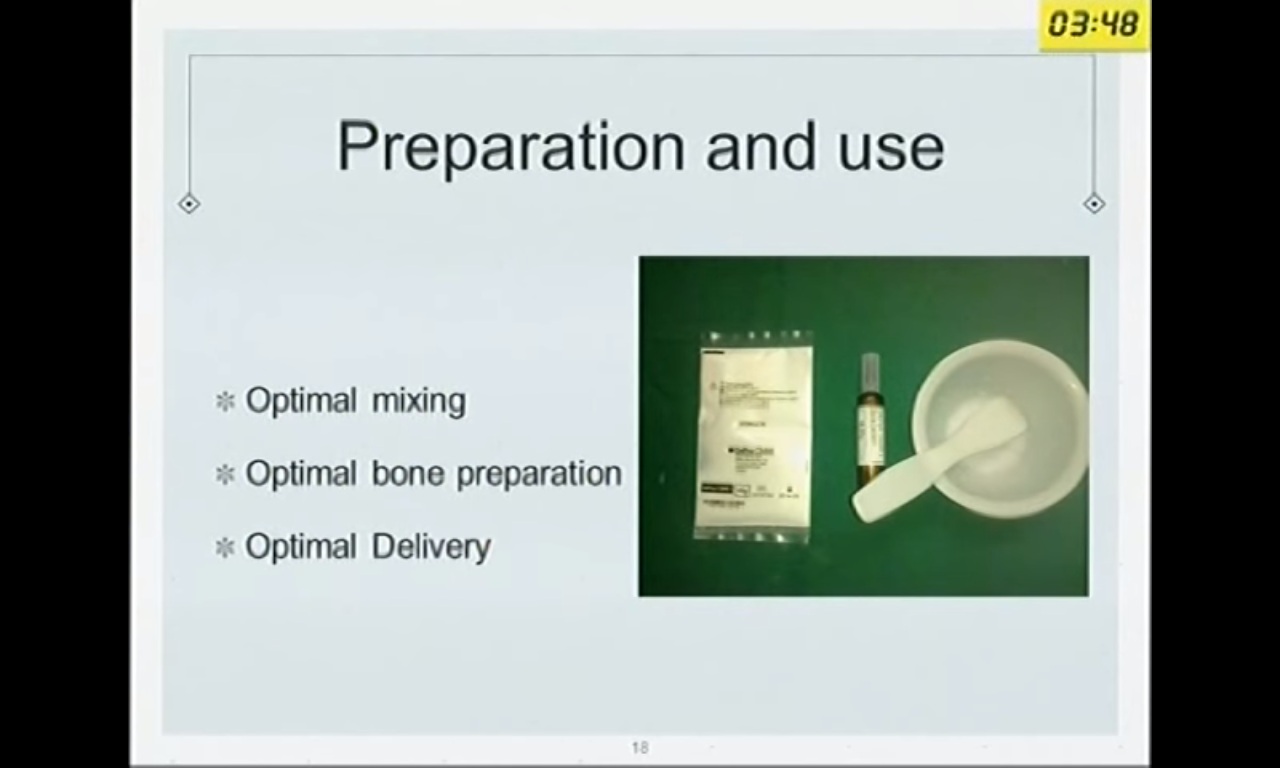
Preparation and Use of Bone Cement
Successful cementation depends on:
-
Optimal mixing technique
-
Proper bone preparation
-
Appropriate cement delivery
Phases of Cement Mixing
There are 4 distinct phases:
1. Mixing Phase
-
Begins with addition of liquid to powder
-
Ends when the mixture becomes homogeneous
-
Polymer beads swell and partially dissolve
-
Viscosity increases but remains relatively low
-
Cement consistency resembles toothpaste and is sticky
2. Waiting Phase
-
Allows further swelling of polymer beads
-
Polymerization progresses
-
Viscosity increases and cement becomes doughy
-
Cement is tested every 5 seconds with gloved fingers
-
Waiting phase ends when cement is neither sticky nor stringy
3. Working Phase
-
Begins when cement is no longer sticky
-
Cement can be applied to bone or implant
-
Polymerization and heat generation continue
-
Cement expands thermally while undergoing volumetric shrinkage
-
Very low viscosity during this phase may allow blood lamination
-
Implant must be inserted before the end of this phase
-
Ends when cement can no longer be kneaded smoothly
4. Setting Phase
-
Cement hardens and polymerization stops
-
Implant must already be in final position
-
Temperature gradually returns to body temperature
-
Cement continues volumetric and thermal shrinkage
Cement Readiness for Implantation
-
Cement is ready when 2 cement balls adhere to each other when touched.
-
If the balls do not stick, the cement has entered the curing stage.
-
Implantation during curing can result in cement delamination from bone or prosthesis.
Timing of Cement Phases
-
Dough time: Approximately 2 to 3 minutes after mixing begins
-
Working time: Approximately 5 to 8 minutes
-
Setting time: Approximately 8 to 10 minutes from start of mixing
Factors Affecting Cement Properties
-
Heat of polymerization
-
Type of cement formulation
-
Powder-to-liquid ratio
-
Each cement is supplied with a fixed ratio to ensure consistency
Bone Preparation
-
Bone preparation is as important as cement preparation.
-
Bone surfaces must be thoroughly cleaned and free of clots.
-
Saline lavage is essential to create a clean bone–cement interface.
-
Pulse lavage and brushes are recommended for optimal cleaning.
-
In severely osteoporotic bone, pulse lavage may not be appropriate.
-
Use of hydrogen peroxide–soaked sponges remains controversial.

Leave a Reply