• Skip to main content
  • Skip to secondary menu
  • Skip to primary sidebar
OrthopaedicPrinciples.com

OrthopaedicPrinciples.com

Integrating Principles and Evidence

Integrating Principles and Evidence

  • Home
  • Editorial Board
  • Our Books
    • Evidence Based Orthopaedic Principles
  • Courses
  • Exams
  • Reviews
  • Live Program
  • Contact

Biomechanics of Screws, Nails and External fixators

Courtesy: Amr Abdelgawad, Maimonaides Medical Centre, NY, USA

BIOMECHANICS OF SCREWS :

  • Inner diameter of the screw is the same as the diameter of the drill bit for the threaded hole.
  • Pitch is distance between two threads.

Screw factors associated with higher pullout Strength (bone quality is the most important factor related to pullout strength):

o Smaller inner diameter.
o Larger outer diameter.
o Fine pitch between two threads.

BIOMECHANICS OF NAILS :

  • Increasing the diameter of solid nail increases bending stiffness to the fourth power.
  • This means that doubling the radius of the nail results in an increase in the bending stiffness by a factor of 16.
  • Both torsion and bending rigidity of nail is proportional to the 4th power of the diameter.
  • The working distance of the nail is the distance between the locking screws closest to the fracture on both sides of the fracture.
  • The longer the working length, the less rigid is the nail (the more motion at fracture side.)
  • The shorter the effective working length of the nail fixation, the stiffer the device.
  • Causes of less rigid nail : titanium nails, less thickness ( less diameter), longer working length of the nail.
  • Dynamic locking screw : placed away from fracture in the oblong hole (to allow dynamization).

BIOMECHANICS OF EXTERAL FIXATION :

Methods to increase the rigidity of an external fixator :

o Pins : increasing pin diameter, increase pin number, increased pin spread within each segment, closer pin to the fracture.
o Rods : increasing the number of connecting rods (stacking), decrease the bone-rod distance, thicker rods and multi planar rods and pins (multiple planes of fixation).
o The single most important factor is the pin diameter because it has an exponential effect.
o Increased pin diameter (despite increase the stability) , may contribute to stress riser formation as bigger hole is now drilled in the bone.

Methods to increase the rigidity of a ring fixator :

  • Increasing the number of wires, tensioning the wires , lower ring size (closer to body), wires closer to fracture , using two rings (stack) on each side, increasing the number of connecting rods between the rings on opposite sides of fracture.
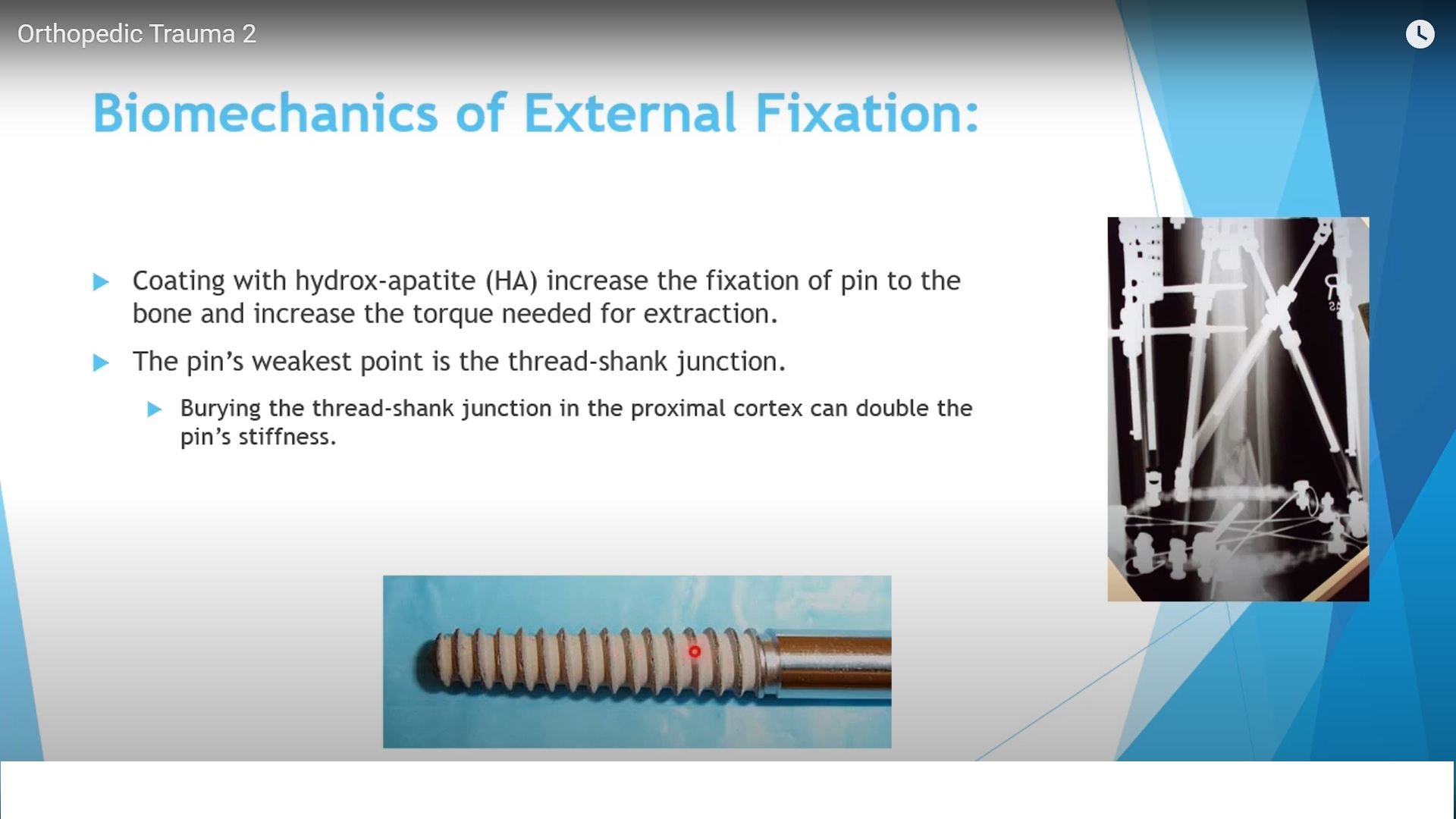
  • Coating with hydrox-apatite (HA) increase the fixation of pin to the bone and increase the torque needed for extraction.
  • The pin’s weakest point is the thread-shank junction.
  • Burying the thread shank junction in the proximal cortex can double the pin’s stiffness.
Post Views: 8,264

Related Posts

  • Biomechanics of External Fixation

    EXTERNAL FIXATION The traditional modern conception of external fixation started with JeanFrancois Malgaigne. The first…

  • Biomechanics of External Fixation

    EXTERNAL FIXATION The traditional modern conception of external fixation started with JeanFrancois Malgaigne. The first…

  • Biomechanics of External Fixation

    EXTERNAL FIXATION The traditional modern conception of external fixation started with JeanFrancois Malgaigne. The first…

Reader Interactions

Comments

  1. shams ullah says

    at

    nicely illustrated

Leave a Reply

Your email address will not be published. Required fields are marked *

Primary Sidebar

Follow Us

instagram slideshare

Categories

  • -Applied Anatomy
  • -Approaches
  • -Basic Sciences
  • -Cartilage & Meniscus
  • -Classifications
  • -Examination
  • -Foot and Ankle
  • -Foot and Ankle Trauma
  • -FRCS(Tr and Orth) tutorials
  • -Gait
  • -Hand and Wrist
  • -Hand and Wrist Trauma
  • -Hand Infections
  • -Hip and Knee
  • -Hip Preservation
  • -Infections
  • -Joint Reconstruction
  • -Knee Arthroplasty
  • -Knee Preservation
  • -Metabolic Disorders
  • -Oncology
  • -OrthoBiologics
  • -OrthoPlastic
  • -Paediatric Orthopaedics
  • -Paediatric Trauma
  • -Patellofemoral Joint
  • -Pelvis
  • -Peripheral Nerves
  • -Principles
  • -Principles of Surgery
  • -Radiology
  • -Rheumatology
  • -Shoulder and Elbow
  • -Shoulder and Elbow Arthroplasty
  • -Spine Deformity
  • -Spine Oncology
  • -Spine Trauma
  • -Spine, Pelvis & Neurology
  • -Sports Ankle and Foot
  • -Sports Elbow
  • -Sports Knee
  • -Sports Medicine
  • -Sports Medicine Hip
  • -Sports Shoulder
  • -Sports Wrist
  • -Statistics
  • -Technical Tip
  • -Technology in Orth
  • -Trauma
  • -Trauma (Upper Limb)
  • -Trauma Life Support
  • -Trauma Reconstruction
  • Book Shelf
  • Book Shelf Medical
  • Careers
  • Case Studies and Free Papers
  • DNB Ortho
  • Evidence Based Orthopaedic Principles
  • Evidence Based Orthopaedics
  • Exam Corner
  • Fellowships
  • Guest Editor
  • Guest Reviews
  • Image Quiz
  • Instructional Course Lectures
  • Journal Club
  • MCQs
  • Meetings and Courses
  • Multimedia
  • News and Blog
  • Plaster Techniques
  • Podcasts
  • Public Health
  • Rehabilitation
  • Research
  • Shorts and Reels
Copyright@orthopaedicprinciples.com. All right rerserved.