
Courtesy: Rishi Dhir, FRCSOrth, Consultant Orthopaedic and Upper Limb Surgeon, Princess Alexandria Hospital, Harlow, UK
Overview
Biomechanics forms the foundation of understanding movement, load transmission, and joint function in Orthopaedics.
These principles are essential for:
- Injury analysis
- Surgical planning
- Implant design
- Clinical decision-making
Force
Definition
A force is a load acting across a particular area.
Unit
- Measured in Newtons (N)
Clinical Relevance
- Related to stress within tissues
- Determines tissue deformation and injury patterns
Newton’s Laws of Motion
First Law – Law of Inertia
- A body remains at rest or in uniform motion unless acted upon by an external force
Clinical Insight
- When:
- Sum of forces = 0
- Sum of moments = 0
The body is in equilibrium
Second Law – Law of Acceleration
F=ma
- Force is proportional to mass and acceleration
Third Law – Action and Reaction
- Every action has an equal and opposite reaction
Orthopaedic Examples
- Ground reaction forces during walking
- Joint reaction forces
Moments (Torque)
Definition
A moment is the turning effect of a force acting at a distance from a pivot.
Formula
M=F×d
Example
- Seesaw principle:
- Larger force – shorter lever arm
- Smaller force – longer lever arm
Couples
Definition
A couple consists of:
- Two equal
- Opposite
- Parallel forces
- Acting at different points
Examples
- Turning a steering wheel
- Opening a bottle cap
Clinical Applications of Force Couples
Shoulder Force Couples
Coronal Plane
- Deltoid – upward pull
- Rotator cuff – downward & medial pull
Maintains centering of humeral head
Rotator Cuff Tear
- Loss of downward force
Superior migration – rotator cuff arthropathy
Transverse Plane
- Subscapularis (anterior)
- Infraspinatus + Teres minor (posterior)
Balance internal and external rotation
Wrist Force Couples
Lunate Function
- Acts as a torque converter
Balances:
- Scaphoid (flexion tendency)
- Triquetrum (extension tendency)
Scapholunate Injury
- Leads to:
- Scaphoid flexion
- Lunate extension
DISI deformity
Levers
Definition
A lever consists of:
- Fulcrum (pivot)
- Force (effort)
- Load (resistance)
Types of Levers
1. First-Class Lever
- Fulcrum between force and load
Examples:
- Seesaw
- Atlanto-occipital joint
2. Second-Class Lever
- Load between fulcrum and force
Example:
- Tiptoe standing (MTP joint)
Most efficient lever
3. Third-Class Lever
- Force between fulcrum and load
Examples:
- Elbow
- Shoulder
Most common in human body
Equilibrium
Definition
A system is in equilibrium when:
- Sum of forces = 0
- Sum of moments = 0
Free Body Diagrams (FBD)
Definition
A simplified representation used to analyze:
- Forces
- Moments
Key Assumptions
Forces
- Joint forces are compressive
Bones
- Treated as rigid structures
Joints
- Considered frictionless hinges
Muscles
- Act only in tension
Additional Assumptions
- No antagonistic muscle activity
- Line of action passes through muscle center
Clinical Applications of Free Body Diagrams
Commonly Applied To
- Hip
- Shoulder
- Elbow
- Knee
- Spine
- Foot
Hip Biomechanics
Lever Type
- First-class lever
Components
- Fulcrum – Femoral head
- Load – Body weight
- Force – Hip abductors
Example Calculation
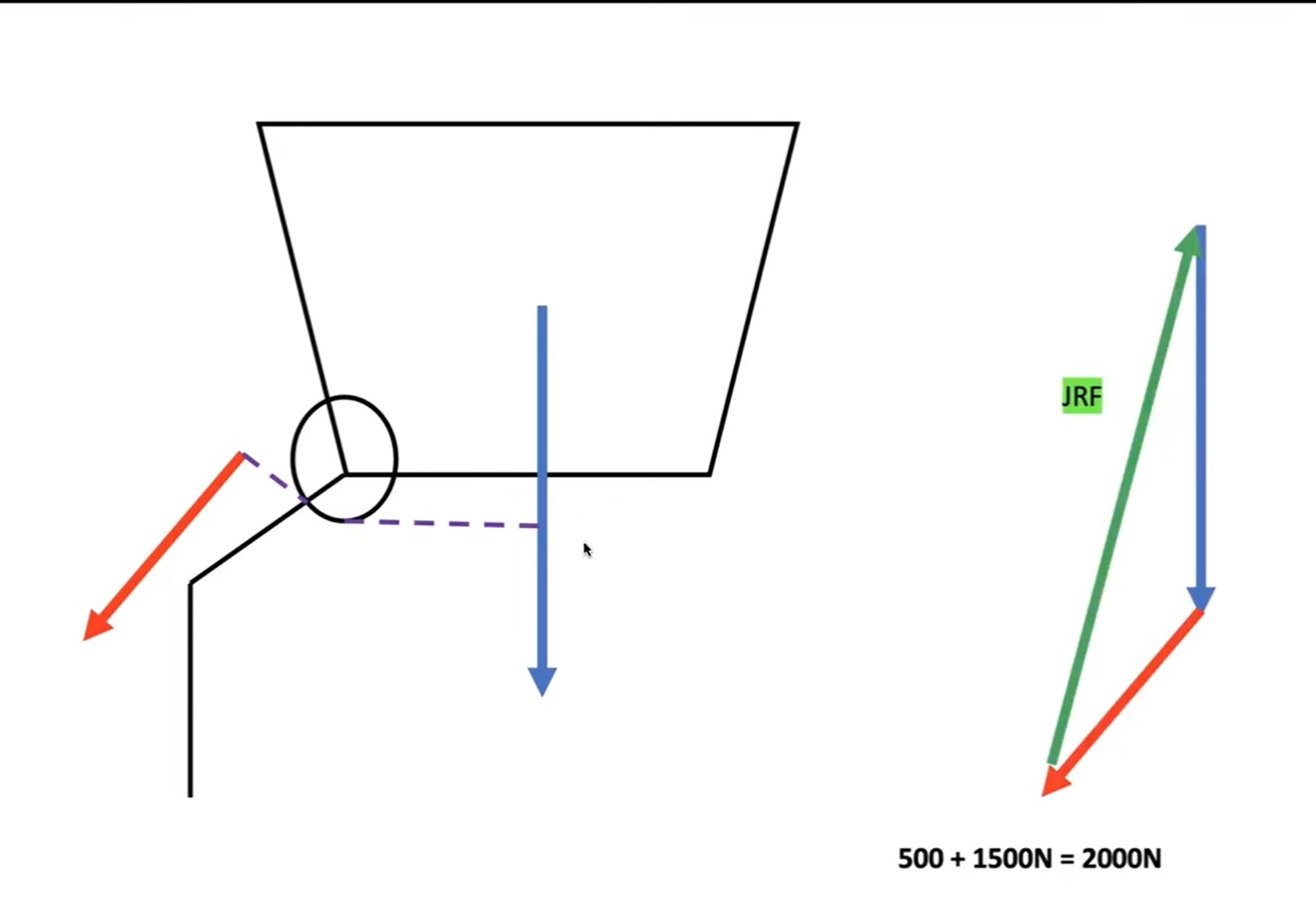
500×15=F×5
Abductor force – 1500 N
Joint Reaction Force
- 2000 N
Clinical Application
Trendelenburg Gait
- Weak abductors
Patient shifts body – reduces joint load
Walking Stick (Opposite Hand)
- Reduces joint reaction force
- Decreases pain
Charnley Arthroplasty
- Medializes hip center
Improves abductor efficiency
Shoulder Biomechanics
Lever Type
- Third-class lever
Components
- Fulcrum – Humeral head
- Force – Deltoid
- Load – Arm weight
Reverse Shoulder Arthroplasty
- Medializes and inferiorizes center of rotation
Improves deltoid function
Elbow Biomechanics
Lever Type
- Third-class lever
Key Point
- Increasing weight in hand:
- Increases muscle force
- Increases joint reaction force
Foot Biomechanics (MTP Joint)
Lever Type
- Second-class lever
Components
- Fulcrum – MTP joint
- Load – Body weight
- Force – Gastrocnemius–soleus
Spine Biomechanics
Lever Type
- First-class lever
Key Insight
- Squatting:
- Increases muscle lever arm
- Reduces spinal load
Patellofemoral Joint Biomechanics
Forces Involved
- Quadriceps force
- Patellar tendon force
Produce compressive joint reaction force
Effect of Patellectomy
- Loss of mechanical advantage
Increased:
- Quadriceps force
- Joint reaction force
Clinical Correlation
- Pain worsens during:
- Stair climbing
- Deep knee flexion
Key Take-Home Points
Core Concepts
- Force, moments, couples, and levers form the basis of biomechanics
- Most joints function as third-class levers
Clinical Relevance
- Helps explain:
- Joint loading
- Injury mechanisms
- Surgical principles
Exam Focus
- Understand:
- Free body diagrams
- Lever systems
- Clinical applications
Leave a Reply