
Courtesy: Rishi Dhir, FRCS Orth, Consultant Upper Limb Surgeon, Princess Alexandra Hospital, Harlow, UK
Genetics
Chromosome Structure
Basic Components
Chromosomes are nuclear structures containing genetic material composed of:
- DNA
- RNA
- Histone proteins
- Non-histone proteins
Human Karyotype
- Total: 46 chromosomes
- 22 pairs of autosomes
- 1 pair of sex chromosomes
Sex Chromosomes
- XX – Female
- XY – Male
Chromosome Anatomy
Parts
- p arm – short arm
- q arm – long arm
- Centromere – separates arms
Types Based on Centromere
| Type | Feature |
|---|---|
| Metacentric | Equal arms |
| Submetacentric | Unequal arms |
| Acrocentric | Very short p arm |
| Telocentric | Centromere at end |
DNA Structure
Components
- Nitrogenous base
- Deoxyribose sugar
- Phosphate backbone
Base Types
Purines
- Adenine (A)
- Guanine (G)
Pyrimidines
- Cytosine (C)
- Thymine (T)
Base Pairing
- A – T
- G – C
Structure
- Double helix
- Hydrogen bonding between bases
Cell Division
Mitosis
- Produces two identical cells
- DNA replication is semi-conservative
Steps
- DNA replication
- Chromosome alignment
- Chromatid separation
- Formation of two identical cells
Protein Synthesis
Transcription
- DNA – mRNA
- Enzyme: RNA polymerase
Translation
- mRNA – Protein
- Involves:
- rRNA
- tRNA
Key Processes
- Replication – DNA – DNA
- Transcription – DNA – RNA
- Translation – RNA – Protein
Chromosomal Abnormalities
Numerical Abnormalities (Aneuploidy)
Monosomy
- Loss of one chromosome
Example: Turner Syndrome (XO)
- Short stature
- Webbed neck
- Cubitus valgus
- Coarctation of aorta
- Infertility
Trisomy
- Extra chromosome
Down Syndrome (Trisomy 21)
- Intellectual disability
- Characteristic facies
- Congenital heart disease
Klinefelter Syndrome (XXY)
- Male with extra X chromosome
- Gynecomastia
- Infertility
- Testicular atrophy
Genetic Terminology
Key Definitions
- Genotype – genetic constitution
- Phenotype – clinical expression
- Allele – variant of a gene
Zygosity
- Homozygous – same alleles
- Heterozygous – different alleles
Mutation Types
- Point mutation – single base change
- Deletion – loss of segment
- Inversion – segment reversed
- Translocation – exchange between chromosomes
Modes of Inheritance
Meiosis
- Produces haploid cells (23 chromosomes)
- Involves:
- Crossing over
- Independent assortment
Autosomal Dominant
Features
- One abnormal allele sufficient
- 50% transmission risk
Examples
- Achondroplasia
- Marfan syndrome
- Osteogenesis imperfecta
Autosomal Recessive
Features
- Two abnormal alleles required
- Parents are carriers
Risk
- 25% affected
- 50% carriers
Example
- Sickle cell disease
X-Linked Recessive
- More common in males
Examples
- Hemophilia
- Duchenne muscular dystrophy
X-Linked Dominant
Example
- Hypophosphatemic rickets
Penetrance and Expressivity
Penetrance
- Probability of gene expression
Variable Expressivity
- Same gene – different severity
Polygenic Inheritance
Definition
- Multiple genes + environment
Examples
- Developmental dysplasia of hip
- Clubfoot
Embryology of the Limb
Timeline
- Occurs between 4–8 weeks gestation
Rule of Threes
Zones
- Apical ectodermal ridge (AER) – limb growth
- Progress zone – cell proliferation
- Zone of polarizing activity (ZPA) – anterior-posterior pattern
Growth Directions
| Direction | Control |
|---|---|
| Proximal – Distal | HOX genes |
| Posterior – Anterior | Sonic hedgehog |
| Dorsal – Ventral | WNT gene |
Associated Abnormalities
- Radial club hand
- Thumb hypoplasia
- Fibular hemimelia
VACTERL Association
- Vertebral
- Anal
- Cardiac
- Tracheoesophageal
- Renal
- Limb anomalies
Important: Associated anomalies may be life-threatening
Embryology of the Spine
Gastrulation (Week 3)
Forms three germ layers:
Ectoderm
- Nervous system
- Skin
Mesoderm
- Bone
- Muscle
- Connective tissue
Endoderm
- GI tract lining
- Respiratory epithelium
Vertebral Development
Key Structures
Notochord
- Forms nucleus pulposus
Somites
Differentiate into:
- Dermatome – skin
- Myotome – muscle
- Sclerotome – vertebrae
Neural Tube Development
Process: Neurulation
- Neural plate – folds – tube
Forms
- Brain
- Spinal cord
Neural Crest
- Peripheral nervous system
Spina Bifida
Types
- Occulta
- Meningocele
- Myelomeningocele
Clinical Sign
- Hair tuft over spine
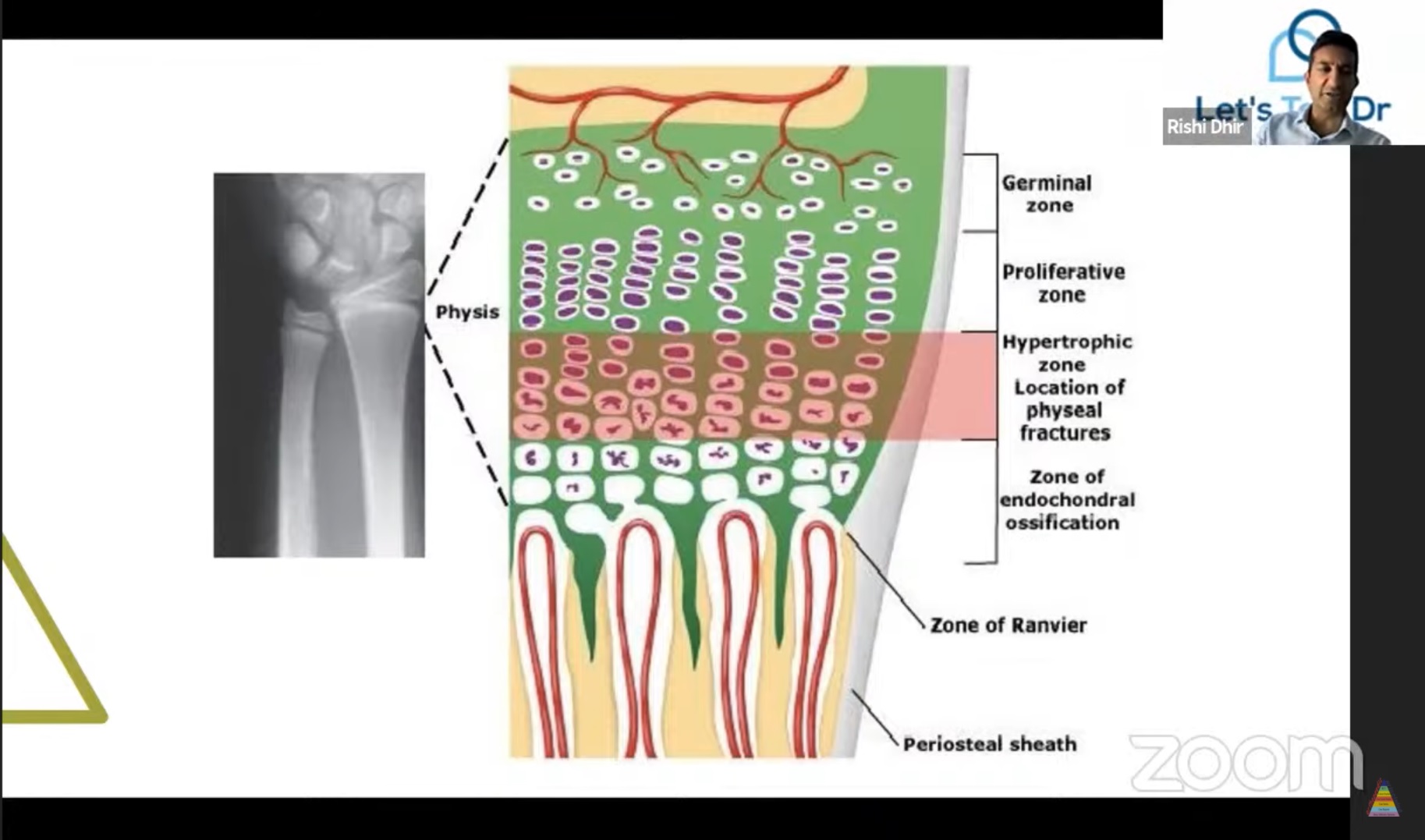
Growth Plate (Physis)
Zones of Physis
1. Resting Zone
- Storage zone
Associated Disorders
- Storage diseases
- Pseudoachondroplasia
2. Proliferative Zone
- Cell division
Associated Disorders
- Achondroplasia
- Gigantism
3. Hypertrophic Zone
- Cell enlargement
- Weakest zone
Site of physeal fractures
Metaphysis
Features
- Contains:
- Primary spongiosa
- Secondary spongiosa
Clinical Importance
- Common site of osteomyelitis
Due to:
- Hairpin vascular loops
- Slow blood flow
Salter–Harris Fractures
Type II
- Physis + metaphysis
- Better prognosis
Type III
- Physis + epiphysis
- Involves germinal layer
Worse prognosis
Complications of Physeal Injury
Complete Arrest
- Limb shortening
Partial Arrest
- Angular deformity
Management of Physeal Bar
Evaluation
- MRI
- CT scan
Treatment Options
- Bar excision + interposition
- Epiphysiodesis
- Corrective osteotomy
Key Take-Home Points
Genetics
- Understand inheritance patterns and mutations
Embryology
- Limb development follows rule of threes
- Spine develops from somites and notochord
Growth Plate
- Hypertrophic zone = weakest point
- Metaphysis = infection-prone
Clinical Insight
- Many Orthopaedic conditions are rooted in:
- Genetic defects
- Developmental abnormalities
Leave a Reply