• Skip to main content
  • Skip to secondary menu
  • Skip to primary sidebar
OrthopaedicPrinciples.com

OrthopaedicPrinciples.com

Integrating Principles and Evidence

Integrating Principles and Evidence

  • Home
  • Editorial Board
  • Our Books
    • Evidence Based Orthopaedic Principles
  • Courses
  • Exams
  • Reviews
  • Live Program
  • Contact

Autonomic Dysreflexia

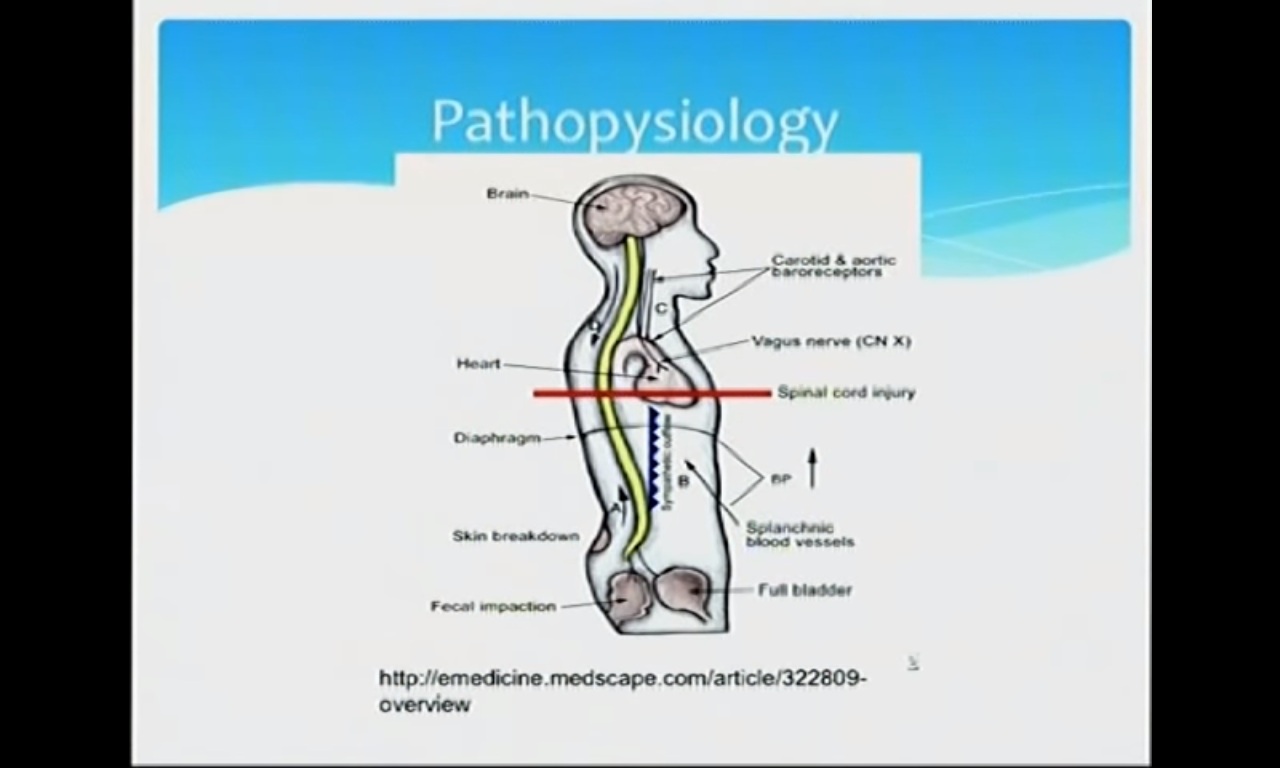
• Autonomic dysreflexia (AD) is an abnormal response to painful stimuli below the level of spinal cord injury (SCI).
• It is usually a sequel to spinal cord injury at T6 or level above that.
• The incidence of AD for SCIs above T6 is between 50% and 70%.
• It can cause very high blood pressure; hence it is a Medical emergency.
• Cognitive and verbal communication impairment may make it difficult for SCI patients to relate symptoms, hence diagnosis is often delayed
• Other causes are spinal cord tumours or after spinal surgery above the level of T6.
• Neurological conditions like multiple sclerosis can present with AD symptoms
• AD may also coexist with other rarer causes of hypertension, for example catecholamine secreting tumours
Post Views: 3,508

Related Posts

  • Cervical Spine Disorders

    Courtesy: Prof Nabil Ebraheim, University of Toledo, Ohio, USA

  • Cervical Spine Instability

    Courtesy: Prof Nabil Ebraheim, University of Toledo, Ohio, USA

  • Lower Limb Orthotics and Prosthetics - ABOS Orthopedic Surgery Board Exam Review

    Courtesy: Jeffrey Cohen NYU Langone Orthopaedics, NYU USA

Reader Interactions

Comments

  1. Ananta Narayan Panda says

    at

    Thank you so much sir
    You have being really helpful
    Automatic dysreflexia was never so clear to me as of now after watching this video
    Thank you so much Hitesh sir

    Plz keep helping us

Leave a Reply

Your email address will not be published. Required fields are marked *

Primary Sidebar

Follow Us

instagram slideshare

Categories

  • -Applied Anatomy
  • -Approaches
  • -Basic Sciences
  • -Cartilage & Meniscus
  • -Classifications
  • -Examination
  • -Foot and Ankle
  • -Foot and Ankle Trauma
  • -FRCS(Tr and Orth) tutorials
  • -Gait
  • -Hand and Wrist
  • -Hand and Wrist Trauma
  • -Hand Infections
  • -Hip and Knee
  • -Hip Preservation
  • -Infections
  • -Joint Reconstruction
  • -Knee Arthroplasty
  • -Knee Preservation
  • -Metabolic Disorders
  • -Oncology
  • -OrthoBiologics
  • -OrthoPlastic
  • -Paediatric Orthopaedics
  • -Paediatric Trauma
  • -Patellofemoral Joint
  • -Pelvis
  • -Peripheral Nerves
  • -Principles
  • -Principles of Surgery
  • -Radiology
  • -Rheumatology
  • -Shoulder and Elbow
  • -Shoulder and Elbow Arthroplasty
  • -Spine Deformity
  • -Spine Oncology
  • -Spine Trauma
  • -Spine, Pelvis & Neurology
  • -Sports Ankle and Foot
  • -Sports Elbow
  • -Sports Knee
  • -Sports Medicine
  • -Sports Medicine Hip
  • -Sports Shoulder
  • -Sports Wrist
  • -Statistics
  • -Technical Tip
  • -Technology in Orth
  • -Trauma
  • -Trauma (Upper Limb)
  • -Trauma Life Support
  • -Trauma Reconstruction
  • Book Shelf
  • Book Shelf Medical
  • Careers
  • Case Studies and Free Papers
  • DNB Ortho
  • Evidence Based Orthopaedic Principles
  • Evidence Based Orthopaedics
  • Exam Corner
  • Fellowships
  • Guest Editor
  • Guest Reviews
  • Image Quiz
  • Instructional Course Lectures
  • Journal Club
  • MCQs
  • Meetings and Courses
  • Multimedia
  • News and Blog
  • Plaster Techniques
  • Podcasts
  • Public Health
  • Rehabilitation
  • Research
  • Shorts and Reels
Copyright@orthopaedicprinciples.com. All right rerserved.