• Skip to main content
  • Skip to secondary menu
  • Skip to primary sidebar
OrthopaedicPrinciples.com

OrthopaedicPrinciples.com

Integrating Principles and Evidence

Integrating Principles and Evidence

  • Home
  • Editorial Board
  • Our Books
    • Evidence Based Orthopaedic Principles
  • Courses
  • Exams
  • Reviews
  • Live Program
  • Contact

Asceptic Loosening- Dr Jacob’s Corner 2

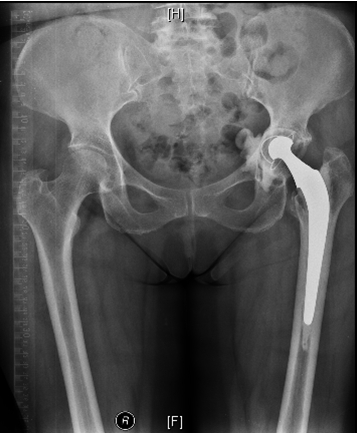
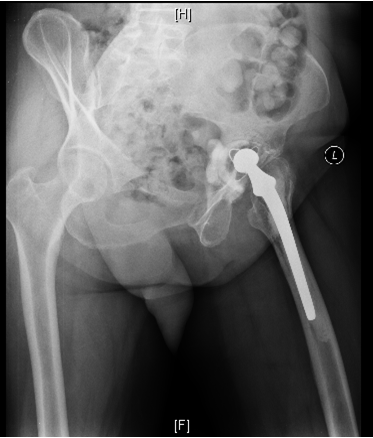
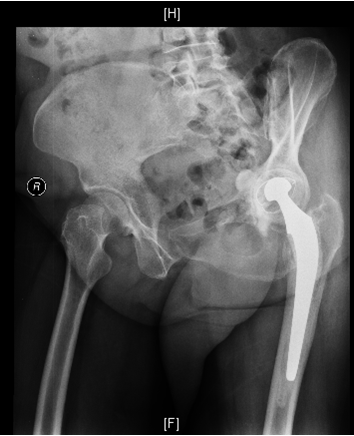
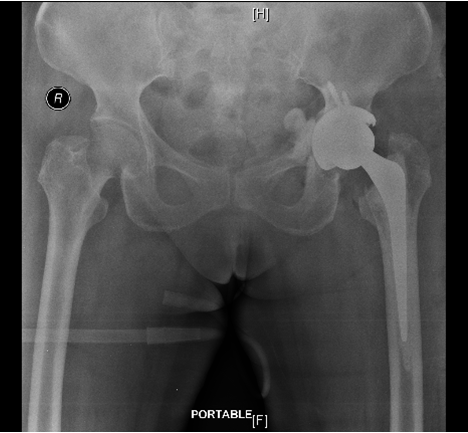
64 year old lady with asceptic loosening of the cup 4 years postoperatively.

What are the possible reasons for failure?

How do we revise the cup?

Do we need to revise the stem?

What are the principles to be adhered to while revising?

Courtesy:Dr Jacob Varghese, Lakeshore hospital, Kochi


Critical Analysis

Why did it fail?
  • Poor acetabular cementing
  • Medial wall penentration  could cause other problems but not loosening.
Tips for good acetabular cementing
  • Dont ream the subchondral bone off
  • The last reamer used should be at least 2 mm or 4 mm more than the cup size to get at least a 2 mm cement mantle with good penetrarion
  • Don’t ream the subchondral bone. Multiple(8 to 10 in no) 4 mm peg holes better than large key holes. Make the key holes wider than the  mouth for macro locking.
  • Dry acetabular bed before cementing
  • Pressurise after inserting doughy cement
  • Apply cement on the back of the cup too to avoid blood at the cement implant interface
  • Insert the cup locking the inferior cement first in an open position before  bringing it to 40 degrees and anterverting. Maintain pressure with the head shaped pusher while removing excess cement from the periphery till its hard
  • Remove any peripheral osteopyhtes to prevent impingement
 Finally it is easier to do an uncemented cup well than a cemented cup for the beginner
 Do we revise the cup alone?
  • If we do this, the dislocation chances are higher due to neck cup impingement. To correct this one needs to revise the stem to use a 32 mm or 36 mm head.
 How do we revise the stem?
a. ETO and distal fixing uncemented stem
b. Cement on cement revision as advised by  Dr. Phil Roberts
We did a cement on cement stem and an uncemented cup without removing the medial cement, obtained could posterior superior contact. Used a high speed drill and stem extraction and cemented a tapered stem with an oxinium on xlpe liner
Post Views: 2,602

Related Posts

  • Dr Jacob's Corner 1

    Courtesy: Dr Jacob Varghese, Head, Division of Joint Reconstruction, Lakeshore Hospital, Kochi A 24 year…

  • Outcome of THA in the young - what do the registers say?

    Courtesy: H. Malchau  

  • Dr Jacob's Corner 1

    Courtesy: Dr Jacob Varghese, Head, Division of Joint Reconstruction, Lakeshore Hospital, Kochi A 24 year…

Reader Interactions

Comments

  1. Praveen says

    at

    I think we have to revise both components. for Reasons i have to look at the post operative 4 yrs back x rays.except for protrusio no big defects.so agai metal on poly cemented.

  2. dr.davidraju M.S.ortho says

    at

    I THINK BOTH COMPONENTS SHOULD BE REPLACED .METAL ON POLY.
    BONE GRAFTING THE FLOOR OF THE ACETABULAM FOR PROTRUSIO
    BECAUSE OF OSTEOLYSIS UPPER END OF FEMUR AND INCONGRUOS ACETABULAR AND FEMORAL HEAD COMPONENTS ARTICULATION AT HIP JOINT LEFT.

  3. daniel says

    at

    sir,
    1. reasons for failure might be (as pre op x ray not available) failure to tackle the primary acetabular pathology probably pre op protrusio , varus hip,probably small sized cup…
    2. revision of cup with placement of bone graft at the floor and bigger size cemented cup with rim
    3.both the components to be replaced.

Leave a Reply

Your email address will not be published. Required fields are marked *

Primary Sidebar

Follow Us

instagram slideshare

Categories

  • -Applied Anatomy
  • -Approaches
  • -Basic Sciences
  • -Cartilage & Meniscus
  • -Classifications
  • -Examination
  • -Foot and Ankle
  • -Foot and Ankle Trauma
  • -FRCS(Tr and Orth) tutorials
  • -Gait
  • -Hand and Wrist
  • -Hand and Wrist Trauma
  • -Hand Infections
  • -Hip and Knee
  • -Hip Preservation
  • -Infections
  • -Joint Reconstruction
  • -Knee Arthroplasty
  • -Knee Preservation
  • -Metabolic Disorders
  • -Oncology
  • -OrthoBiologics
  • -OrthoPlastic
  • -Paediatric Orthopaedics
  • -Paediatric Trauma
  • -Patellofemoral Joint
  • -Pelvis
  • -Peripheral Nerves
  • -Principles
  • -Principles of Surgery
  • -Radiology
  • -Rheumatology
  • -Shoulder and Elbow
  • -Shoulder and Elbow Arthroplasty
  • -Spine Deformity
  • -Spine Oncology
  • -Spine Trauma
  • -Spine, Pelvis & Neurology
  • -Sports Ankle and Foot
  • -Sports Elbow
  • -Sports Knee
  • -Sports Medicine
  • -Sports Medicine Hip
  • -Sports Shoulder
  • -Sports Wrist
  • -Statistics
  • -Technical Tip
  • -Technology in Orth
  • -Trauma
  • -Trauma (Upper Limb)
  • -Trauma Life Support
  • -Trauma Reconstruction
  • Book Shelf
  • Book Shelf Medical
  • Careers
  • Case Studies and Free Papers
  • DNB Ortho
  • Evidence Based Orthopaedic Principles
  • Evidence Based Orthopaedics
  • Exam Corner
  • Fellowships
  • Guest Editor
  • Guest Reviews
  • Image Quiz
  • Instructional Course Lectures
  • Journal Club
  • MCQs
  • Meetings and Courses
  • Multimedia
  • News and Blog
  • Plaster Techniques
  • Podcasts
  • Public Health
  • Rehabilitation
  • Research
  • Shorts and Reels
Copyright@orthopaedicprinciples.com. All right rerserved.