
Courtesy: Prof Nabil Ebraheim, University of Toledo, Ohio, USA
Ankle Sprain – Evaluation, Tests, Diagnosis, and Treatment
General Concepts
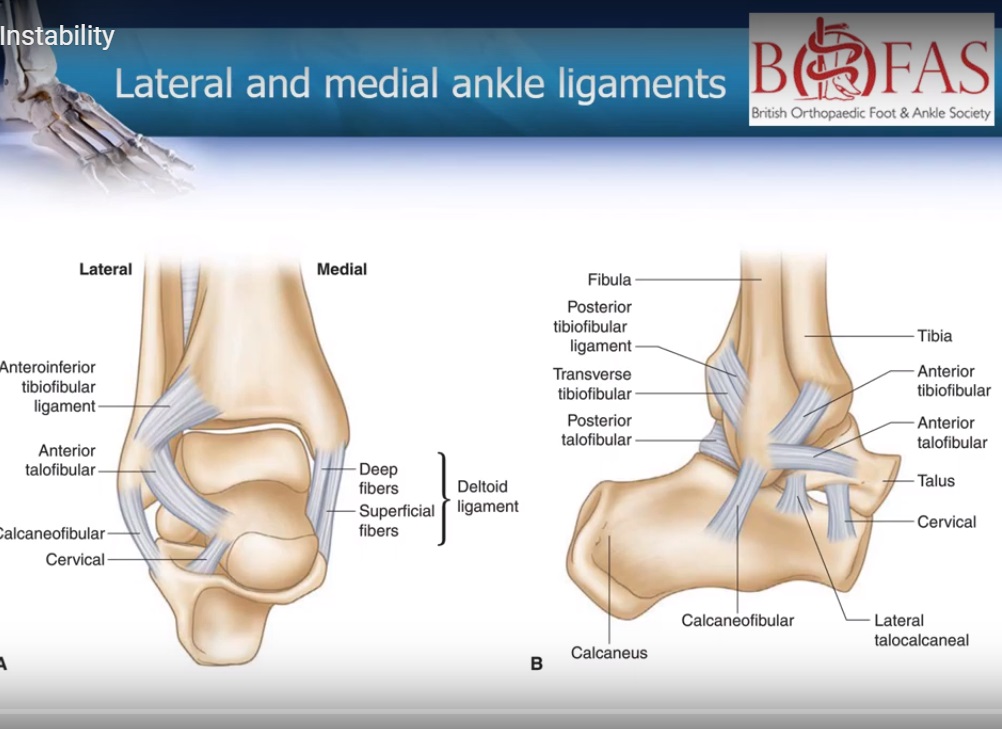
- Ankle ligaments are complex stabilizers of the ankle joint
- Injury to these ligaments = ankle sprain
Types of Ankle Sprain
- Low ankle sprain
- Lateral ligament injury (most common)
- High ankle sprain
- Syndesmotic injury (less common, more severe)
Conditions That Mimic Ankle Sprain
- Osteochondral lesion of the talus
- Peroneal tendon subluxation
- Fracture of lateral talar process
- Fracture of anterior calcaneal process
- Syndesmotic injury
Imaging Indication
- If patient cannot bear weight:
- Obtain ankle X-ray
Medial Ligament Injury (Deltoid Ligament)
- Occurs on medial side of ankle
Key Features
- Often associated with fractures
- May be:
- Occult
Diagnosis
- May require:
- Stress radiographs
Lateral Ankle Sprain (Low Ankle Sprain)
- Involves lateral ligament complex
Most Commonly Injured Ligament
- Anterior talofibular ligament (ATFL)
Reason
- Weakest ligament
- Stressed in plantarflexion
Anterior Drawer Test
Purpose
- Assess ATFL integrity
Method
- Ankle in ~20° plantarflexion
- Compare with opposite side
Positive Test
- >/=9 mm anterior translation OR
- >/=5 mm difference vs normal side
Calcaneofibular Ligament (CFL) Injury
- Usually injured after ATFL
Test: Talar Tilt Test
Purpose
- Assess CFL integrity
Normal Value
- <5° tilt
High Ankle Sprain (Syndesmotic Injury)
Definition
- Injury to:
- Distal tibiofibular syndesmosis
Clinical Importance
- Often requires:
- Surgical treatment
Important Associated Injury
Maisonneuve fracture
Components
- Proximal fibular fracture
- Syndesmotic injury
- Deltoid ligament injury
Key Point
- Always examine:
- Proximal fibula
Tests for Syndesmotic Injury
1. Squeeze Test
Method
- Compress tibia and fibula at mid-calf
Positive Test
- Pain at distal syndesmosis
2. External Rotation Stress Test
Method
- Ankle in neutral
- Apply external rotation force
- Obtain mortise X-ray
Radiographic Indicators
- Tibiofibular clear space >5 mm
- Medial clear space >4 mm
Key Clinical Points
- Most ankle sprains:
- Lateral ligament injuries (low ankle sprain)
- ATFL:
- Most commonly injured ligament
- Always rule out:
- Syndesmotic injury
- Maisonneuve fracture
- High ankle sprains:
- More severe
- Often require surgery
Leave a Reply