• Skip to main content
  • Skip to secondary menu
  • Skip to primary sidebar
OrthopaedicPrinciples.com

OrthopaedicPrinciples.com

Integrating Principles and Evidence

Integrating Principles and Evidence

  • Home
  • Editorial Board
  • Our Books
    • Evidence Based Orthopaedic Principles
  • Courses
  • Exams
  • Reviews
  • Live Program
  • Contact

Anatomy of the Lumbosacral Plexus

Courtesy: Prof Nabil Ebraheim, University of Toledo, Ohio, USA

Overview

The lumbosacral plexus is a complex network of nerves that supplies:

  • Lower limb
  • Gluteal region
  • Perineum

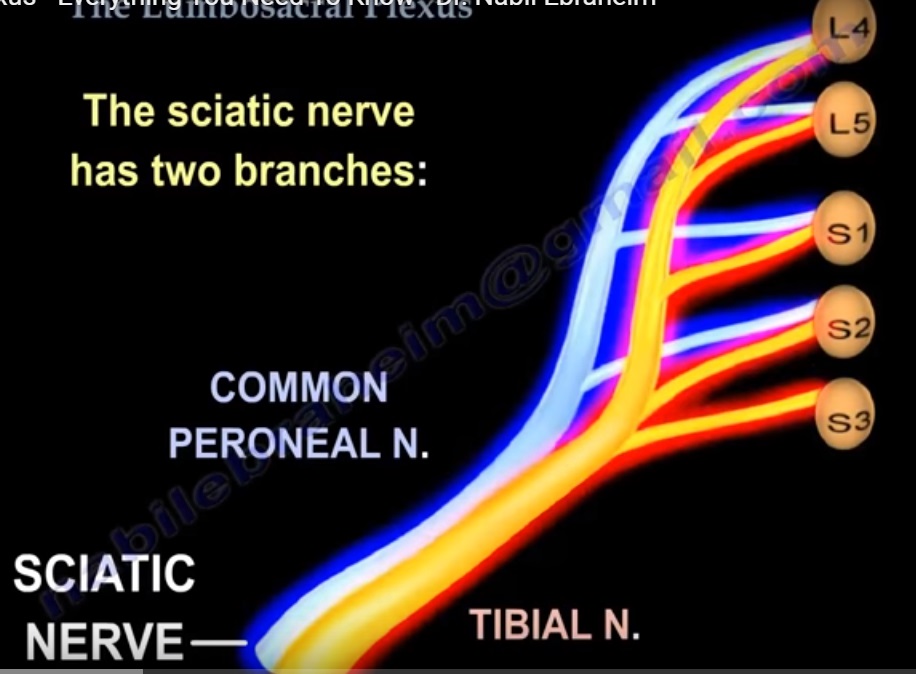
It is formed by the combination of lumbar and sacral nerve roots, with the sciatic nerve being its largest and most important component.


Formation of the Lumbosacral Plexus


Nerve Roots

The plexus is formed by:

  • L4
  • L5
  • S1
  • S2
  • S3
  • S4

Key Points

  • The sciatic nerve arises from L4–S3
  • The S4 root contributes to other branches of the plexus

Sciatic Nerve


Origin

Formed from:

  • L4
  • L5
  • S1
  • S2
  • S3

 It is the largest nerve in the human body


Terminal Branches

The sciatic nerve divides into:

  • Tibial nerve
  • Common peroneal (fibular) nerve

Function

  • Supplies most of the muscles and skin of the leg and foot

Major Branches of the Lumbosacral Plexus


1. Superior Gluteal Nerve

Roots

  • L4, L5, S1
  • Predominant: L5

Motor Supply

  • Gluteus medius
  • Gluteus minimus
  • Tensor fasciae latae

Clinical Significance

  • Injury —} Trendelenburg gait (hip abductor weakness)

2. Inferior Gluteal Nerve

Roots

  • L5, S1, S2
  • Predominant: S1

Motor Supply

  • Gluteus maximus

Function

  • Hip extension
  • Essential for:
    • Rising from sitting
    • Climbing stairs

3. Posterior Cutaneous Nerve of Thigh

Roots

  • S1, S2, S3

Function

  • Sensory supply to:
    • Posterior thigh
    • Part of gluteal region

4. Pudendal Nerve

Roots

  • S2, S3, S4

Function

  • Supplies:
    • Perineal muscles
    • Perineal skin

Clinical Importance

  • Essential for:
    • Urinary continence
    • Fecal continence

Pattern of Nerve Root Contribution


Sequential Organization

A consistent pattern is observed:

  • Each nerve is formed from three consecutive nerve roots
  • Each subsequent nerve starts one level lower

Pattern Summary

Nerve Roots
Superior gluteal nerve L4, L5, S1
Inferior gluteal nerve L5, S1, S2
Posterior cutaneous nerve S1, S2, S3
Pudendal nerve S2, S3, S4

Key Concept

  • The sciatic nerve (L4–S3) is the central axis of the plexus
  • Other nerves branch in a stepwise descending pattern

Summary Points

  • The lumbosacral plexus is formed from L4–S4 nerve roots
  • The sciatic nerve (L4–S3) is the principal nerve
  • It divides into:
    • Tibial nerve
    • Common peroneal nerve

Important Branches

  • Superior gluteal nerve
  • Inferior gluteal nerve
  • Posterior cutaneous nerve of thigh
  • Pudendal nerve

Clinical Insight

  • Nerve root patterns follow a predictable sequence, aiding:
    • Clinical diagnosis
    • Neurological localization

Post Views: 2,808

Related Posts

  • Lumbar Plexus #Anatomy

    Courtesy: Prof Nabil Ebraheim, University of Toledo, Ohio, USA

  • Lumbosacral Plexus

    Courtesy: Prof Nabile Ebraheim,University of Toledo,Ohio, USA

  • Brachial Plexus #Anatomy- Overview

    Courtesy: Prof Nabile Ebraheim, University of Toledo, Ohio, USA

Reader Interactions

Leave a Reply

Your email address will not be published. Required fields are marked *

Primary Sidebar

Follow Us

instagram slideshare

Categories

  • -Applied Anatomy
  • -Approaches
  • -Basic Sciences
  • -Cartilage & Meniscus
  • -Classifications
  • -Examination
  • -Foot and Ankle
  • -Foot and Ankle Trauma
  • -FRCS(Tr and Orth) tutorials
  • -Gait
  • -Hand and Wrist
  • -Hand and Wrist Trauma
  • -Hand Infections
  • -Hip and Knee
  • -Hip Preservation
  • -Infections
  • -Joint Reconstruction
  • -Knee Arthroplasty
  • -Knee Preservation
  • -Metabolic Disorders
  • -Oncology
  • -OrthoBiologics
  • -OrthoPlastic
  • -Paediatric Orthopaedics
  • -Paediatric Trauma
  • -Patellofemoral Joint
  • -Pelvis
  • -Peripheral Nerves
  • -Principles
  • -Principles of Surgery
  • -Radiology
  • -Rheumatology
  • -Shoulder and Elbow
  • -Shoulder and Elbow Arthroplasty
  • -Spine Deformity
  • -Spine Oncology
  • -Spine Trauma
  • -Spine, Pelvis & Neurology
  • -Sports Ankle and Foot
  • -Sports Elbow
  • -Sports Knee
  • -Sports Medicine
  • -Sports Medicine Hip
  • -Sports Shoulder
  • -Sports Wrist
  • -Statistics
  • -Technical Tip
  • -Technology in Orth
  • -Trauma
  • -Trauma (Upper Limb)
  • -Trauma Life Support
  • -Trauma Reconstruction
  • Book Shelf
  • Book Shelf Medical
  • Careers
  • Case Studies and Free Papers
  • DNB Ortho
  • Evidence Based Orthopaedic Principles
  • Evidence Based Orthopaedics
  • Exam Corner
  • Fellowships
  • Guest Editor
  • Guest Reviews
  • Image Quiz
  • Instructional Course Lectures
  • Journal Club
  • MCQs
  • Meetings and Courses
  • Multimedia
  • News and Blog
  • Plaster Techniques
  • Podcasts
  • Public Health
  • Rehabilitation
  • Research
  • Shorts and Reels
Copyright@orthopaedicprinciples.com. All right rerserved.