
Courtesy: Prof Nabil Ebraheim, University of Toledo, Ohio, USA
Overview
- The lumbosacral plexus is a network of nerves supplying the lower limb, gluteal region, and perineum.
- It is formed by the combination of lumbar and sacral nerve roots.
- The sciatic nerve is the most important and largest nerve within this plexus.
- Understanding the sciatic nerve and its branches is essential for understanding the organization of the lumbosacral plexus.
Formation of the Lumbosacral Plexus
Nerve Roots
The lumbosacral plexus is formed from:
- L4
- L5
- S1
- S2
- S3
- S4
Key points:
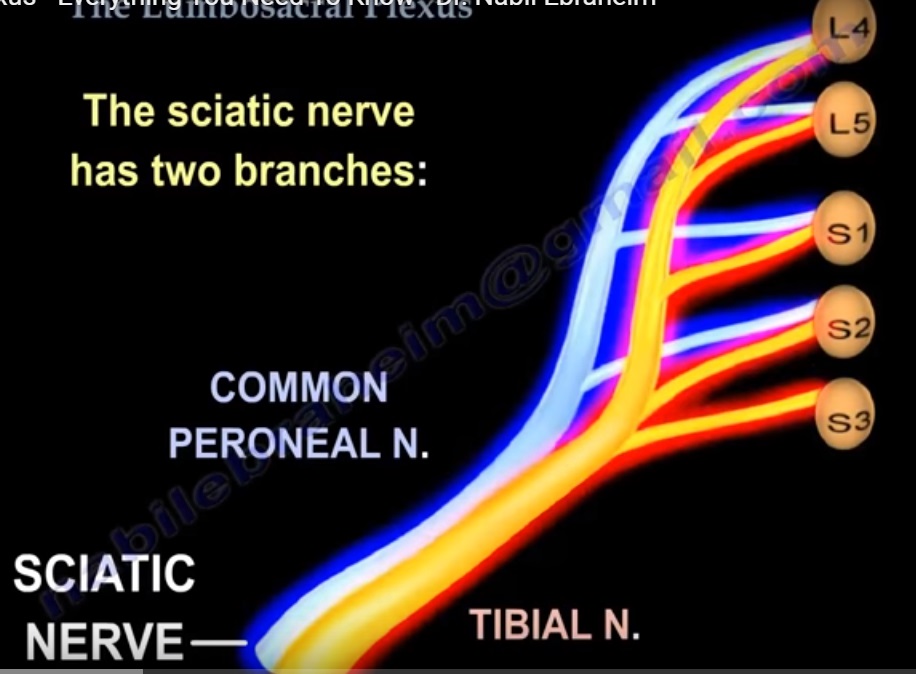
- The sciatic nerve arises from L4 to S3.
- The addition of S4 contributes to other branches of the lumbosacral plexus.
Sciatic Nerve
Origin
- Formed from the spinal nerve roots:
- L4
- L5
- S1
- S2
- S3
- It is the largest nerve in the body and a major component of the lumbosacral plexus.
Branches of the Sciatic Nerve
The sciatic nerve divides into two major terminal branches:
- Tibial nerve
- Common peroneal nerve
These branches supply most of the muscles and skin of the leg and foot.
Important Branches of the Lumbosacral Plexus
Several additional nerves arise from the lumbosacral plexus.
Superior Gluteal Nerve
- Nerve roots: L4, L5, S1
- Predominant root contribution: L5
Motor supply:
- Gluteus medius
- Gluteus minimus
- Tensor fasciae latae
Clinical significance:
- Injury may lead to Trendelenburg gait due to weakness of hip abduction.
Inferior Gluteal Nerve
- Nerve roots: L5, S1, S2
- Predominant root contribution: S1
Motor supply:
- Gluteus maximus muscle
Function:
- Important for hip extension during activities such as rising from a seated position or climbing stairs.
Posterior Cutaneous Nerve of the Thigh
- Nerve roots: S1, S2, S3
Function:
- Provides sensory innervation to the posterior aspect of the thigh and parts of the gluteal region.
Pudendal Nerve
- Nerve roots: S2, S3, S4
Function:
- Supplies muscles and skin of the perineum.
- Important for urinary and fecal continence.
Pattern of Nerve Root Contribution
An important pattern is observed in the nerve root composition of these branches.
Each branch is formed from three consecutive nerve roots, and each successive nerve begins with a root one level lower than the previous branch.
The sequence is:
- Superior gluteal nerve: L4, L5, S1
- Inferior gluteal nerve: L5, S1, S2
- Posterior cutaneous nerve of the thigh: S1, S2, S3
- Pudendal nerve: S2, S3, S4
Key Concept
- The sciatic nerve (L4–S3) forms the central component of the lumbosacral plexus.
- Other nerves branch off in an organized pattern involving three consecutive nerve roots.
- Each subsequent nerve begins with the next lower spinal level.
Summary Points
- The lumbosacral plexus is formed from L4 to S4 nerve roots.
- The sciatic nerve (L4–S3) is the principal nerve of this plexus.
- It divides into the tibial nerve and common peroneal nerve.
- Additional important branches include:
- Superior gluteal nerve
- Inferior gluteal nerve
- Posterior cutaneous nerve of the thigh
- Pudendal nerve
- Many branches follow a pattern of three consecutive nerve roots shifting one level downward.


Leave a Reply