
Courtesy: Prof Nabil Ebraheim, University of Toledo, Ohio, USA
Leg Compartments
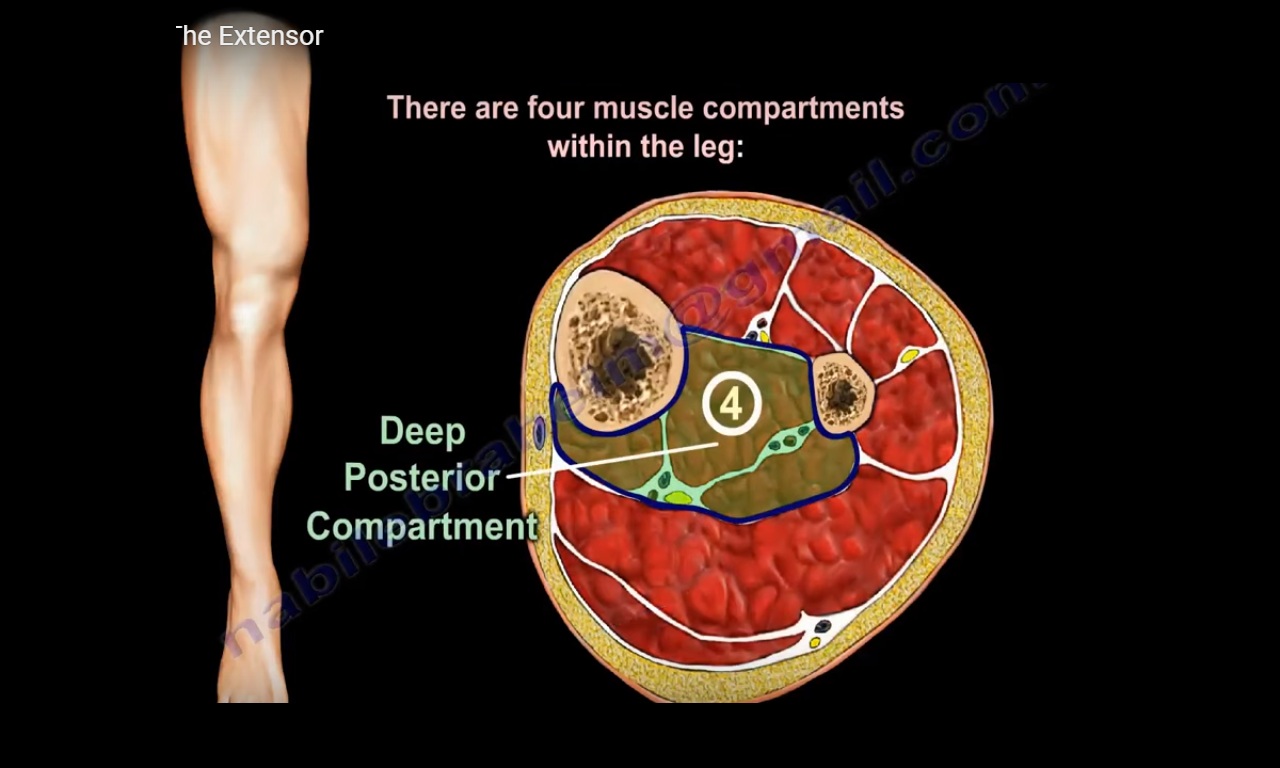
- The leg contains four compartments: anterior, lateral, superficial posterior, and deep posterior.
- The extensor digitorum longus lies in the anterior compartment of the leg.
Muscles of the Anterior Compartment
- Tibialis anterior.
- Extensor hallucis longus.
- Extensor digitorum longus.
- Peroneus tertius.
- All muscles in the anterior compartment are supplied by the deep peroneal (deep fibular) nerve.
Origin
- Lateral condyle of the tibia.
- Upper three-fourths of the anterior surface of the fibula.
- Interosseous membrane.
Insertion
- Divides into four tendons.
- Inserts into the middle and distal phalanges of the lateral four toes.
Course of Tendons
- The tendon forms above the superior extensor retinaculum.
- Passes under the superior and inferior extensor retinacula.
- Divides into four tendons distal to the retinaculum.
Function
- Dorsiflexion of the ankle.
- Extension of the lateral four toes.
Innervation
- Deep peroneal (deep fibular) nerve.
Important Sensory Landmark
- Injury to the deep peroneal nerve causes numbness in the first web space of the foot.
Relation to the Anterior Tibial Artery
- Anterior tibial artery enters anterior compartment through the interosseous membrane.
- Proximally it runs between tibialis anterior (medial) and extensor digitorum longus (lateral).
- Distally the artery runs between extensor hallucis longus (medial) and extensor digitorum longus (lateral).
Arrangement of Structures at the Anterior Ankle
- Mnemonic: ‘Tom Has A Very Nice Dog’.
- T – Tibialis anterior.
- H – Extensor hallucis longus.
- A – Anterior tibial artery.
- V – Vein.
- N – Deep peroneal nerve.
- D – Extensor digitorum longus.


Leave a Reply