
Courtesy: Prof Nabil Ebraheim, University of Toledo, Ohio, USA
Overview
The obturator artery is a key pelvic vessel supplying:
- The medial thigh
- Structures around the hip joint
Clinical Importance
Understanding its anatomy is essential in:
- Pelvic trauma
- Acetabular fracture surgery
- Total hip arthroplasty
Anatomical variations can lead to significant hemorrhage if injured
Origin of the Obturator Artery
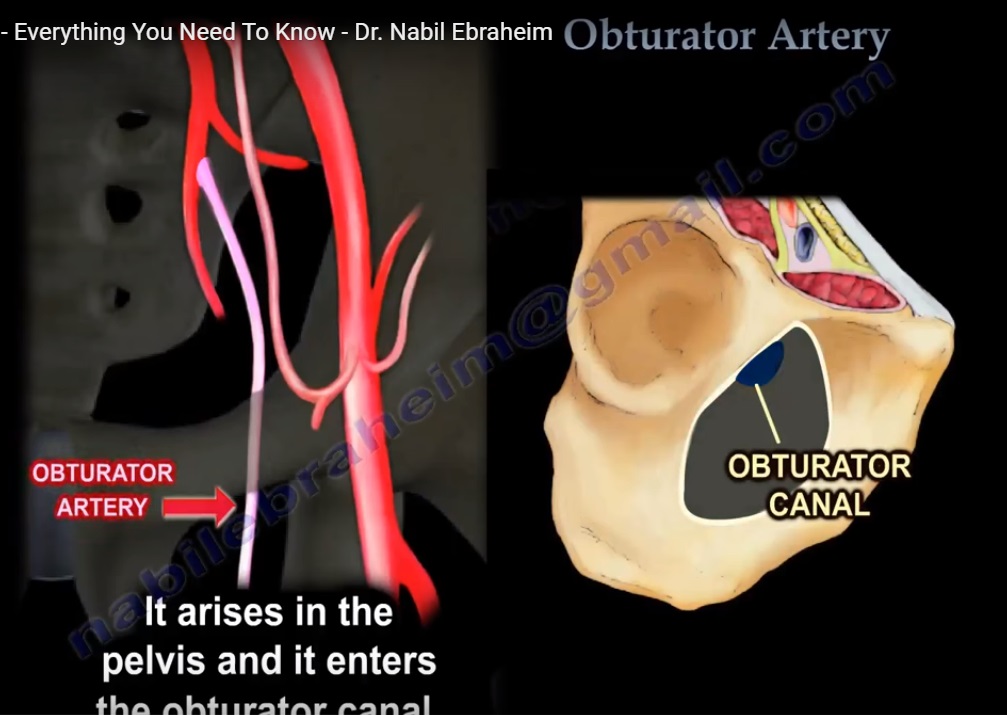
- Typically arises from the anterior division of the internal iliac artery
- Originates within the pelvis and courses toward the obturator canal
Course
- Runs along the lateral pelvic wall
- Enters the obturator canal
- Passes from the pelvis into the medial compartment of the thigh
Division of the Obturator Artery
Within the obturator canal, it divides into:
- Anterior branch
- Posterior branch
Arrangement
- These branches form a vascular ring around the obturator membrane
Branches of the Obturator Artery
1. Acetabular Branch
- Passes through the ligament of the head of the femur
- Supplies a small portion of the femoral head
2. Muscular Branches
- Supply the adductor muscles of the medial thigh
Important Anatomical & Clinical Considerations
Corona Mortis (“Crown of Death”)
Definition
A vascular connection between:
- Obturator vessels (internal iliac system)
- External iliac system (commonly via inferior epigastric vessels)
Characteristics
- Often venous, but arterial variants exist
- Incidence varies widely
Location
- Approximately 3–7 cm from the pubic symphysis
- Lies posterior and superior to the superior pubic ramus
Clinical Significance
At Risk During
- Pelvic trauma
- Pelvic fracture surgery
- Ilioinguinal approach
Complication
- Can cause severe, difficult-to-control hemorrhage
Hence the term “crown of death”
Acetabular Screw Placement in Total Hip Arthroplasty
Importance
Safe screw placement requires awareness of neurovascular structures around the acetabulum
Quadrant System
Method
- Draw a line from ASIS to the center of the acetabulum
- A perpendicular line divides it into four quadrants
Danger Zones
Anterior Inferior Quadrant
- Contains obturator vessels
Anterior Superior Quadrant
- Contains external iliac vessels
These quadrants should be avoided for screw placement
Surgical Risks Involving the Obturator Artery
1. Retractor Placement
Risk
- Injury if placed beneath the transverse acetabular ligament
- Risk increases when positioned too anteriorly
2. Transverse Acetabular Ligament
Anatomy
- Bridges the acetabular notch, forming a tunnel
- Allows passage of vessels into the joint
Surgical Tip
- If division is required:
- Release from the posterior half
Reduces risk of vascular injury
- Release from the posterior half
3. Pelvic Fracture Reduction
Technique Consideration
- Reduction clamps are commonly used
Safer Approach
- Apply clamps from the medial side of the pelvic ring
Avoids lateral neurovascular structures
Summary Points
- The obturator artery arises from the internal iliac artery (anterior division)
- Travels through the obturator canal and divides into anterior and posterior branches
- Provides an acetabular branch to the femoral head
- Corona mortis is a critical vascular variation with high bleeding risk
- Knowledge of acetabular quadrants is essential for safe screw placement
- Careful surgical technique is required to avoid vascular injury during pelvic procedures

Leave a Reply