
Courtesy: Prof Nabil Ebraheim, University of Toledo, Ohio, USA
Overview
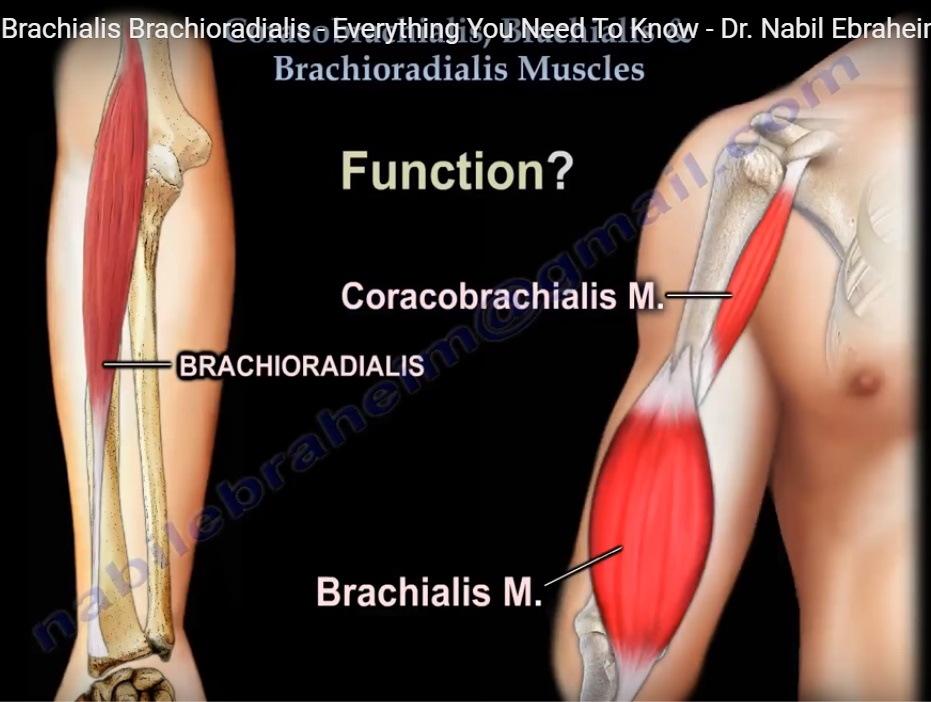
The coracobrachialis, brachialis, and brachioradialis are commonly confused due to:
-
Similar-sounding names
-
Their role in flexion movements
-
Their location along the anterior aspect of the upper limb
Simple Memory Tip
Think in proximal – distal order:
-
Coracobrachialis – Shoulder (proximal)
-
Brachialis – Arm (mid-region)
-
Brachioradialis – Forearm (distal)
1. Coracobrachialis
Origin
-
Coracoid process of the scapula
Shared Origin
-
Short head of biceps brachii
-
Together form the conjoint tendon
Insertion
-
Middle third of the medial surface of the humeral shaft
Nerve Supply
-
Musculocutaneous nerve
Key Anatomical Feature
-
The musculocutaneous nerve pierces the coracobrachialis muscle
-
Typically occurs 3–8 cm distal to the coracoid process
Functions
-
Shoulder flexion
-
Adduction of the arm
-
Stabilization of the glenohumeral joint
Surgical Importance
-
The musculocutaneous nerve passes through this muscle
-
At risk during:
-
Anterior shoulder approaches
-
Coracoid exposure
-
Retraction of the conjoint tendon may result in nerve injury
Clinical Correlation
Injury to the musculocutaneous nerve leads to:
-
Weak elbow flexion
-
Sensory loss over the lateral forearm
Reason
-
Terminal branch: Lateral antebrachial cutaneous nerve
2. Brachialis
Origin
-
Distal half of the anterior surface of the humerus
Insertion
-
Coronoid process of ulna
-
Ulnar tuberosity
Nerve Supply
Unique Feature: Dual Innervation
-
Musculocutaneous nerve
-
Radial nerve
Function
-
Primary flexor of the elbow
Key Point
-
Acts in all forearm positions (pronation and supination)
-
Unlike biceps, its function is independent of forearm rotation
Surgical Importance
-
During anterior approach to the humeral shaft:
-
The brachialis is split along its nerve supply plane
-
Advantage
-
Protects:
-
Musculocutaneous nerve
-
Radial nerve
-
3. Brachioradialis
Origin
-
Proximal two-thirds of the lateral supracondylar ridge of humerus
Insertion
-
Lateral surface of the distal radius
-
Near the radial styloid process
Nerve Supply
-
Radial nerve
Key Concept
-
Although a flexor, it is supplied by an extensor compartment nerve
Function
-
Strong elbow flexor
-
Most effective in mid-pronation (neutral position)
Example
-
Handshake position
Clinical Importance
1. Indicator of Radial Nerve Recovery
-
First muscle to regain function in radial nerve palsy
2. Surgical Landmark
-
Radial nerve can be accessed between:
-
Brachialis
-
Brachioradialis
-
3. Relation to Superficial Radial Nerve
-
The superficial branch:
-
Runs beneath brachioradialis
-
Lies lateral to the radial artery
-
Clinical Condition: Wartenberg Syndrome
Cause
-
Compression of the superficial radial nerve
Symptoms
-
Pain over the radial side of the wrist
-
Sensory disturbance over the dorsolateral hand
Comparison Table
| Feature | Coracobrachialis | Brachialis | Brachioradialis |
|---|---|---|---|
| Location | Proximal arm | Mid arm | Distal arm / forearm |
| Origin | Coracoid process | Anterior humerus | Lateral supracondylar ridge |
| Insertion | Medial humerus | Coronoid process of ulna | Radial styloid |
| Nerve Supply | Musculocutaneous | Musculocutaneous + Radial | Radial nerve |
| Function | Shoulder flexion & adduction | Primary elbow flexor | Elbow flexion (neutral position) |
Key Exam Pearls
Coracobrachialis
-
Musculocutaneous nerve pierces the muscle
Brachialis
-
Main elbow flexor
-
Demonstrates dual innervation
Brachioradialis
-
Flexor supplied by the radial nerve
-
First muscle tested in radial nerve palsy
Leave a Reply