
Courtesy: Prof Nabil Ebraheim, University of Toledo, Ohio, USA
Ankle Arthritis: Clinical Presentation and Management
Clinical Presentation
Common Symptoms
Patients with ankle arthritis typically present with:
- Long-standing, diffuse ankle pain
- Pain localized within the ankle joint
- Antalgic or altered gait
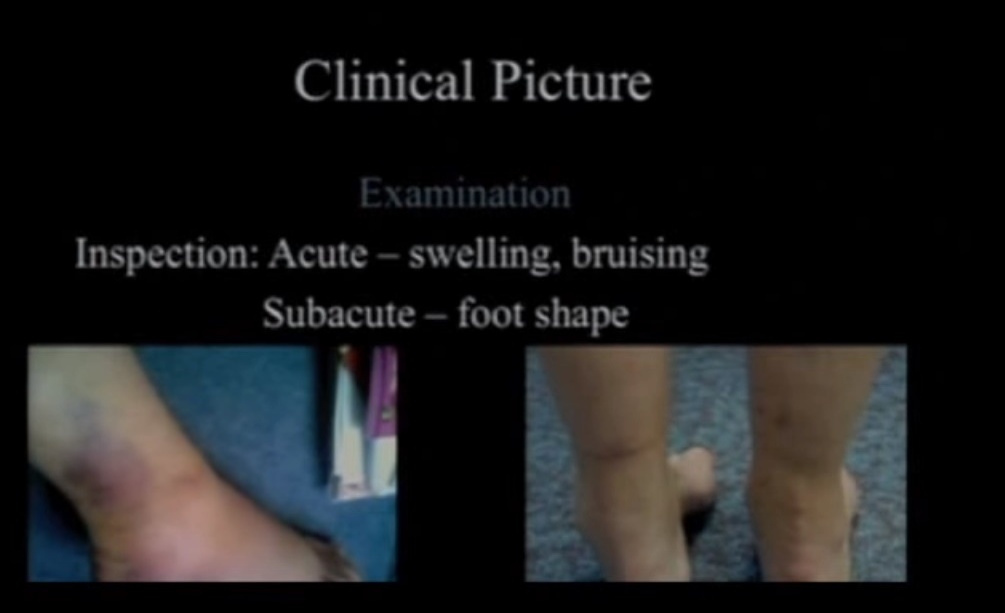
- Swelling
- Reduced range of motion
Sensory Assessment
- Performed using Semmes–Weinstein 5.07 monofilament testing
Clinical Importance
- Significant sensory loss– poor candidate for Total Ankle Replacement (TAR)
Initial (Conservative) Management
General Principle
Non-operative treatment is the first-line approach.
Treatment Options
Medications
- Anti-inflammatory drugs
Activity Modification
- Reduce high-impact activities
Orthoses and Bracing
- Single rocker sole shoe modification
- Custom Arizona brace
Injections
- Corticosteroid injections
- Viscosupplementation
Assistive Devices
- Cane or walking aid if required
Surgical Options
1. Ankle Arthrodesis (Fusion)
Indications
- Failed conservative treatment
- Younger, high-demand patients
- Patients unsuitable for TAR:
- Diabetes
- Obesity
- Poor soft tissue condition
Technique
- Fusion of the tibiotalar joint
- Fixation using:
- Screws
- Plates
- Combination constructs
Optimal Positioning
- Neutral ankle flexion
- 0–5° hindfoot valgus
Important Considerations
- Avoid plantarflexed fusion
- May lead to knee hyperextension during gait
- Consider:
- Gastrocnemius or Achilles recession
- If neutral dorsiflexion cannot be achieved
Outcomes
- High union rate: 85–90%
- Reliable pain relief
Long-Term Complication
- Adjacent joint arthritis
- Particularly subtalar joint
- ~50% incidence at 10 years
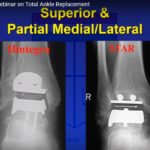
2. Total Ankle Replacement (TAR)
Indications
- Elderly, low-demand patients
- Desire to preserve ankle motion
Common Causes
- Post-traumatic arthritis (~80%)
- Inflammatory arthritis:
- Rheumatoid arthritis
- Gout (selected cases)
Contraindications
Absolute
- Severe deformity
- Avascular necrosis of talus
- Poor soft tissue envelope
- Active infection
Relative
- Ligament instability
- Diabetes
- Smoking
- Osteoporosis
- Morbid obesity
- Young, high-demand patients
Advantages
- Preserves ankle motion
- Improved gait mechanics compared to fusion
Risks and Limitations
- Higher complication rates than fusion
- Higher revision rates
- Wound complications (especially in rheumatoid arthritis)
- Implant loosening or subsidence
- More common in patients <55 years
Preoperative Evaluation
- Rule out infection
- Assess for metabolic bone disease
- CT scan for:
- Bone stock
- Alignment
Surgical Planning Tip
- Preserve fibula when possible
- Allows future conversion to TAR if needed
Decision-Making
General Principles
- Older, low-demand patients – TAR preferred
- Younger, active patients – Arthrodesis preferred
Clinical Rule
If uncertainty exists:
Arthrodesis is the safer option
Key Takeaways
- Total ankle replacement is:
- Increasingly popular
- Technically demanding
- Patient selection is critical for successful outcomes
- Arthrodesis remains:
- Reliable
- Predictable
- Gold standard in many cases
Comparison
Total Ankle Replacement
- Preserves motion
- Better gait
- Higher complication and revision rates
Arthrodesis
- Excellent pain relief
- Durable results
- Risk of adjacent joint arthritis
Final Clinical Insight
Treatment choice should be individualized based on:
- Patient age
- Activity level
- Comorbidities
- Degree of deformity

Leave a Reply